Monday, November 11, 2013

KADC fall retreat in Townsend, Tenn.: Beef cabbage soup and dulcimers on the "peaceful side of the Smokies"

When I go to a dulcimer workshop or a music festival, my first thoughts aren't about the food. Brats, burgers and chili taste better at a festival, but they're just bratwurst, burgers and chili. And institutional food, even at the John C. Campbell Folk School, Western Carolina University or Our Lady of the Snows in suburban St. Louis, still reminds me of dorm food. I'm there for the music, not the food.

But at the Knoxville Area Dulcimer Club's fall retreat over the weekend, the beef and cabbage soup at lunch Saturday was so good, I asked for the recipe. It's linked below.

KADC's retreat was held at the Townsend Church of God, in the mountain resort community of Townsend 30 miles south of Knoxville. Members of the congregation served meals in the church gymnasium, and the cabbage soup was one of the choices Saturday noon. It featured ground beef, kidney beans and tomatoes in addition to the cabbage in a beef broth -- perfect for a fall day.

The Rev. Jeff Dockery, who co-pastors the church with his wife Angie, found the recipe on line -- on the Everyday Manna website hosted by Lisa Smith of Living Faith Television. Dockery grew up in the restaurant business, and he has a good eye for flavorful recipes that are easy to prepare and feed a lot of people.

"We make it a lot, and it's our favorite soup," he said.

Dockery says he believes the church is called to be involved in projects that help the community. He hopes it provides a good venue for KADC, and he knows it's good advertising for Townsend. He said Mike Clemmer of the Wood-N-String Dulcimer Shop on U.S. 321 brought KADC and the church together.

"They were looking for a venue, and Mike down at the dulcimer shop said, 'Have you talked to the Church of God?'" said Dockery.

They talked. And as a result, the retreat has been at the Church of God for a couple of years now.

It seems like a good fit. The KADC retreat is intentionally small, and I think the words matter: It felt like a "retreat," not a festival. It wasn't a wham-bam-thank-ye-ma'am rush from one class to the next like at so many festivals, and I felt like it gave me a chance to grow musically. Perhaps even spiritually. Which, of course, is what retreats are supposed to do.

Here's the link to that recipe:

at http://www.everydaymanna.net/index.php?option=com_content&view=article&id=380:beef-cabbage-soup&catid=36:main-dishes&Itemid=18

'Peaceful Side of the Smokies'

Townsend (population 244) is only 20 or 25 miles from the bumper-to-bumper traffic and major tourist destinations to the east at Pigeon Forge and Gatlinburg, but it's a whole different world. It consists mostly old-fashioned motels, inner tube rentals, craft shops and barbecue-, steak- and trout restaurants strung out along U.S. 321 and Old State Highway 73 leading into the Great Smoky Mountains National Park. Its vacation guide, published by the daily newspaper in nearby Maryville, calls it "The Peaceful Side of the Smokies."

It's also a knowledgeable side of the Smokies.

Or maybe it's just more relaxed than the big tourist destinations.

Saturday afternoon Debi and I went to the IGA to pick up a couple of items, and a clerk at the register noticed our wooden KADC name badges in the shape of a hammered dulcimer.

"Oh," she said. "Are you in town for a dulcimer conference?"

We said we were, and we chatted about music a minute or two.

Dulcimers aren't part of the regional culture in Illinois, where I live now, and I think most people couldn't identify one if they saw it in a police lineup. So I was impressed.

No doubt they'd also be familiar with dulcimers in Gatlinburg and Pigeon Forge, which also have a lot of genuine mountain crafts and some very fine luthiers, but I don't know if the clerks in a grocery store there would have time to chat about them.

Family dulcimers in southern Ohio

Among the instructors and performers at KADC's retreat were Kendra Ward and Bob Bence of southern Ohio, who publish the Upcreek Productions Let's Jam! fake books. In addition to several numbers on hammered dulcimer and guitar, they played "Uncloudy Day" on a two-person courting dulcimer that had been in Kendra's family -- Bob playing backup while Kendra strummed the melody traditional style, using a noter and letting the drone ring out on the open strings. She said several generations of her family played the mountain dulcimer, but they called it another name.

"I never heard it called a dulcimer until the late 1970s ... in our area, they just called them 'dulcerines,'" she said.

I wasn't familiar with the term, but it is "a recognized southern Ohio variant name for dulcimer," according to a comment by Ken Hume in the thread "where are the heads?" in the Making Dulcimers group of the Friends of the Mountain Dulcimer website June 22, 2011, 9:24 a.m.

Kendra Ward, who grew up along the Ohio River near Gallipolis (up river from Parkersburg, W.Va.), has posted pictures of the family instruments to the forum on History of Dulcimers and Songs, under the heading "Dulcerine Pictures" on the the EverythingDulcimer.com website. She also mentions the term, along with reminiscences of her father playing "fiddle tunes and old standards like Grandfather's Clock" with a noter creating a "resonant buzz ... the ancient sound of the dulcimer," in an article "By TAB or By Ear: I'll Take Both, Please." in the Spring 2010 issue of Dulcimer Players News.

Tuesday, November 05, 2013

Prairieland Strings -- dulcimer tab for Christmas, and clips of the English version of "Away in a Manger"

Some clips to supplement our playlist for the Advent supper Dec. 18 ...

One of the tunes we'll play is "Away in a Manger" from Maureen Sellers' Simply Christmas tablature book. This is not the usual American version -- it's English, and it has a much nicer melody, IMHO. Maureen has both melody and harmony parts in her book. Of the several dulcimer tab versions available on line, the only one that has this melody is in a discussion thread headed "Away in a Manger - Richard Wilson dulcimer 1-5-8-5 tuning" -- on the Friends of the Mountain Dulcimer website. It has a very nice 2:17-minute sound clip by Robin Clark. He says:

Here is 'Away in a Manger' played on my 1981 Richard Wilson dulcimer - it is a fine instrument I have it set 4 string equidistant and tuned 1-5-8-5 for this recording today. I've just checked and the instrument is smack on D-A-d-A (a bit of a surprise to be that accurate because I just tuned it up from slack without using a tuner ). Here's a useless fact - When I was eleven years old I sang the second verse to this carol as part of a trio for the live broadcast BBC Christmas Concert from the Royal Albert Hall.
FOTMD is a wonderful resource, BTW, and I've just joined (member page at

http://mountaindulcimer.ning.com/profile/PeterEllertsen

once I figure out what to do with it.) For a link to a PDF file of the melody of "Away in a Manger" in standard notation, scroll down to Wilson's reply, which is the second one under "Replies to this Discussion, and open the attachment. If that doesn't work, here's a direct link to the PDF file.

Two videos follow. The first is a lovely English choral arrangement, complete with boy sopranos, by the King's College Choir at England's Cambridge University in 2001:

The second gives us the full Celtic Woman stage treatment in a (bootlegged?) telecast of a concert performance:

Also on the tentative playlist:

-- "Joy to the World" - Tull Glazener's arrangement, available on the internet at Glazener's website.

-- "O Come all Ye Faithful" -- R.L> Walker of the Dogwood Dulcimer Association of Pensacola, Fla., has an online arrangement that looks pretty straightforward. I haven't tried to play it (I've never really had the patience to play from tab), but let's print out copies and take a run at it Thursday.

We'll also do four songs from Steve Eulberg's book of Christmas ensemble arrangements, Deck the Halls. There's more about the arrangements, including an audio clip of two songs we'll be doing, "In the Bleak Midwinter" and a video clip of "Still, Still, Still" on Steve's Owl Mountain Music website. (Eulberg means "owl mountain" in German.) We'll also play "The First Nowell" and "Silent Night."

Thursday, October 31, 2013

Tai Chi and Qigong -- warmup videos

Daily Qigong - 4 minute exercise. www.TaiChiHealthProducts.org presents a 4-minute daily QIGONG exercise. Join in with Instructor Don Fiore. Stretching and breathing are important for senior and elderly health - and good for all ages. The movements can be done while sitting or standing. TaiChiHealthProducts.org has more Senior and Holistic Health Tips and Exercise Programs.

Daily Tai Chi - join in this 9-minute exercise. TaiChiHealthProducts.org presents a 9-minute "Easy Tai Chi" to do daily. Join in with Don Fiore and see how you feel afterwards. Great for a senior fitness routine and home workout. Helps with balance, coordination, circulation, and strengthening bones and muscles. The movements come from our "Easy TaiChi-Qigong" DVD that can be ordered on TaiChiHealthProducts.org - a website for Holistic Health Tips and Exercises.

http://youtu.be/PNtWqDxwwMg (9:06)

Fiore's bio at http://www.selfgrowth.com/experts/don_fiore.html.

Easy Qigong & Easy Tai Chi - Senior Exercise. TaiChiHealthProducts.org presents Don Fiore sharing Easy Qigong and Tai Chi movements with his Senior students at Sun Lakes, The Terraces, and SCAN Health Plan Arizona. Join in with the exercises. The complete Senior Exercise Program DVD called "Easy TaiChi-Qigong" is on the .ORG website. This DVD is recommended as a resource by the National Parkinson Association website and the Maximum Life website. Music: CMA's "Who We Are" and Erin Jacobsen's "Feather on the Breath of God." Video by Tori Fiore Film Projects. Don is giving Teacher Training with Certificates for "Easy Tai Chi & Qigong". For more info: TaiChiDon@aol.com

Wednesday, October 30, 2013

Richard and Mimi Fariña on Pete Seeger's TV show / also Donovan singing "Colours"

One of the people I really listened to when I was starting to play the mountain dulcimer in the 1970s was Richard Fariña. Even in Knoxville, Tennessee, which should have been (but wasn't always) a stronghold of Appalachian traditional music! So it was a revelation tonight to find some video clips of his playing on Pete Seeger's "Rainbow Quest" ... with some nice closeups of his left hand action with the noter. Worth studying.

Richard & Mimi Fariña -- "Dopico" and "Celebrations for a Grey Day." YouTube user realdinho, who posted it, says "the first couple of songs performed on Rainbow Quest hosted by Pete Seeger, originally broadcast Saturday, February 26, 1966 about two months before Richard's tragic death on 30 April 1966, the day Mimi turned 21..."

Other songs featuring the Fariñas on "Rainbow Quest"

Neal Hellman of Gourd Music, who put together a book of tablature in the 1970s, has a very nice profile of Fariña on his blog Neal's Tales at http://gourdmusic.blogspot.com/2010/05/liberating-richard.html. Including this:

... One evening he saw the Kentucky folk singer Jean Ritchie perform at folk club in Greenwich Village and became smitten by the mountain dulcimer. This, he decided, would be the perfect vehicle for his poetry. He soon married and toured with Carolyn Hester, but the relationship proved a disaster and ended in 1962. Folk legend has it that Carolyn pulled a gun on Richard in their Paris apartment shortly after he flirted with a young girl in a café. There are many stories like that surrounding the short life of Richard Fariña, all of which only added to his mystique.

In the spring of 1962 while still in Paris he met a sixteen-year-old dancer named Mimi Baez, and within a year they were married. The Baez family was skeptical of Richard at first, but in time his charm and wit won them over. Mimi and Richard composed music together on guitar and dulcimer, and by 1964 they were becoming a well-known folk duo. They recorded two wonderfully inspired and well-produced recordings for Vanguard Records—Celebrations for A Gray Day (April 1965) and Reflections in a Crystal Wind (December 1965). Their music consisted of Richard’s songs of political and social commentary as well as instrumentals he created for the mountain dulcimer. Mimi added her soprano harmony and played guitar and autoharp. They reached their peak at the Newport Folk Festival in 1965, where even a massive thunderstorm could not keep the crowds from dancing to their music, all in various forms of undress.

And this: "He took the dulcimer out of the Appalachians and made it accessible to city kids like me. To anyone over forty who plays the dulcimer, Richard Fariña has earned patriarchal status." Hellman, like Farina, was originally from Brooklyn.

Bonus track: Donovan on Pete Seeger show

Pete Seeger & Donovan - Colours. Posted by YouTube user Jan Hammer. "Speaking of UK artists here is Scottish singer/songwriter Donovan appearing with Pete Seeger on the Show "Rainbow Quest".

Excerpt from background on "Rainbow Quest":

Rainbow Quest (1965--66) was a U.S. television series devoted to folk music and hosted by Pete Seeger. It was videotaped in black-and-white and featured musicians playing in traditional American music genres such as traditional folk music, old-time music, bluegrass and blues. The show's title is drawn from the lyrics of the song by Seeger "Oh, Had I A Golden Thread".

Production

The program was produced on a low budget funded by Seeger and his co-producer, Sholom Rubinstein. Seeger's wife, Toshi, given the title "Chief Cook and Bottle Washer" in the closing credits after each show, actually functioned as the director by dint of the fact that she continually made suggestions to Rubinstein that he passed along to the camera operators. Eventually the cameramen simply followed her instructions without waiting for Rubinstein to repeat them. ...

Monday, October 21, 2013

Random thoughts on the Cas Walker song; some Zen moments at Don Pedi's "Tao of Dulcimer" retreat in Little Switzerland, N.C.; Carolina-style barbecue, Brother Jack's and other East Tennessee nostalgia

It's all in the bowin'. Learning the notes is fine, but ... -- Don Pedi

Some notes from Don Pedi's "Tao of Dulcimer" weekend Oct. 17-20 at Wildacres Retreat off the Blue Ridge Parkway at Little Switzerland, N.C. They're not in any particular order, and I made no attempt to cover the main points of the weekend. Instead, I jotted down notes when subjects came up that especially interested me. ...

Also a video clip of an iconic commercial touting Knoxville grocer Cas Walker's supermarkets that I played during a song-sharing circle the first night of the retreat. I promised to tab it out if anyone was interested.

Don is a T'ai Chi instructor in the lineage of T.T. Liang, and he's been conducting "Tao of Dulcimer" retreats for several years now. He bills them as a "relaxed, friendly, and non-competitive" weekend of traditional music and elementary T'ai Chi exercises. "Most people find these retreats fun, as well as a source of inspiration and rejuvenation," he says. And the weekend lived up to his billing

So there was a lot of music, philosophy, meditation and -- really -- a Zen-like quality floating around the mountaintop all weekend. A couple of highlights:

  • On simplicity. Traditional North Carolina musician Frank Proffitt's reaction to Earl Scruggs' famous bluegrass banjo style: "Boy, I'd like to know how to do that, and not do it!"

  • Zen philosophy, in seven words. "We live. We die. Get over it."
Frank Proffitt played a variety of instruments, including the mountain dulcimer, but he was especially known as a master of the traditional Appalachian fretless banjo. So his opinion of Scruggs' flashy but influential banjo-picking style carries considerable weight.

Other highlights follow. In no particular order of importance.

The Cas Walker song

For people of a certain age, Cas Walker's singing commercial was as much a part of the Knoxville experience as the Midday Merry-Go-Round, J. Bazzel Mull's Singing Convention, Krystal hamburgers, Brother Jack's or bluegrass night at Buddy's Barbecue on Kingston Pike. And driving through Knoxville on my way to Carolina put me in a nostalgic frame of mind.

So the Cas Walker song is what popped into my head Friday night at the dulcimer retreat when I got stumped during a song circle.

And I was really stumped for a minute there. I don't know the common dulcimer jam tunes in DAD well enough to lead them, but one of the folks from a Nashville-area dulcimer club had just played a Dolly Parton song (I forget which one), and the first thing that came to mind was the way Dolly Parton her start on Walker's "Farm and Home Show." So I blurted out, "Well, there's always the Cas Walker song." It goes like this:

Pick up your morning paper when it hits the street,
Cas Walker's prices can't be beat.
Try our Blue Band coffee and you'll ask for more.
Do all your (grocery) shopping, at a Cas Walker store (2x)

Cas Walker, who was a grocer, a flamboyant politician and something of an impresario, went off the air more than 30 years ago, but even today there's a Cas Walker tribute band fronted by a guy who played on the TV show. Here's footage by Keith McDaniel of Secret City Films in nearby Oak Ridge, of "Cas Walker" with David West and the Cider Mountain Boys:

A Cas Walker impersonator?!?

But it's not a bad likeness, and the song comes on at 0:25. Dolly Parton sang it on her 1994 Heartsongs album.

I remember the chorus as "do all your shopping at a Cas Walker store," but others -- including Dolly Parton and Knoxville Metro Pulse staff writer Betty Bean, who wrote a fine profile of Walker for the entertainment magazine in 1998 shortly before his death, remember it as "do your grocery shopping." She describes it like this:

... For anyone past the age of 25, no memory of an East Tennessee childhood is complete without a Cas Walker's Farm and Home Hour vision of Red Rector's Vienna-sausage fingers flying over the mandolin strings and Honey Wilds' big mitts whaling on the little ukulele he called his chili dipper. There were David West's hot banjo licks and, clear as yesterday morning, Curly Dan Bailey's high, lonesome tenor soaring on the "Do your grocery shopping" part of the Farm and Home Hour theme song, with yodeling Claude Boone calling out "Say that again," and all of them standing in front of the big painting of Cas treeing a whole family of coons and joining in to harmonize on the "...at a Cas Walker store" finale.

Contributors to a nostalgia thread "Can Anyone tell me what happened to Archies Restaurant and Cas Walker Supermarkets?" on the City-Data.com website, also remember it that way. But Knoxville blogger Jack Mabe, who heard it played not long ago at a senior center north of Knoxville, remembers it as I do: "When Larry hit the high notes on Cas's song (Do all your shoppin' at the Cas Walker store...), I looked around the room and saw nothing but smiles." Larry Mathis and Bud Brewster, who also played on the show, were the featured guests.

Mabe also repeats a characteristic story of Walker's days on the Knoxville City Council, about " the time Cas showed up late for a Knoxville city council meeting." He was recalled after a short while as mayor, was immediately elected to the council and served there for many years.

"Mr. Walker..." the clerk said as Cas walked in the door.

"I'm agin' it," Cas replied.

The clerk was calling the roll.

The Farm and Home Show was on WBIR-TV for many years, and I'll bet it was played both ways at one time or another.

[For a WBIR-TV news special "Thumpin' Good: Cas Walker's Legacy in East Tennessee," click here and follow the links to embedded highlights from his show. Almost as famous as the "Pick up your morning paper ..." jingle, especially toward the end of Walker's career in the 1970s and early 80s, was the "Thumpin' Good" watermelon commercial, here sung by amateur YouTube user 22fast.]

Richard Farina

Don, who got his start playing the dulcimer when he heard Richard and Mimi Farina in concert in Cambridge, Mass., says Farina played the dulcimer mostly in DAA, and mostly with a noter. But not always. Don demonstrated -- on "Hamish" (?) -- how he'd dog-nose two-note chords. It's as much a way of getting more texture in the drone as it is chording, and "dog-nosing" probably isn't the correct term for it; that's what I called it in East Tennessee when we played parallel thirds by fretting the melody string with the index finger and trailing it two frets down on the middle string and strumming across all the strings. It also works to play parallel fourths or fifths in different tunings.

Some North Carolina tunes

  • "Asheville" -- a variant of "Flop-Eared Mule" but faster -- at least the way Don plays it -- and with more embellishment.
  • "Take the Train to Charlotte" -- essentially the same tune as "Going Down Town" or "Going Down to Lynchburg." Played in G, but sometimes traditionally in D.
  • "Christmas Goose" -- Don composed it one time in a recording studio, early in his career, to fill out a cassette tape. Aeolian mode.
  • "Sheepy and the Goat" -- Children's song. Pentatonic? DAD. Don taught it at a junior high school in western Carolina, came back a year later and the kids had all learned it from each other. Like a revival of the oral tradition.
"Sheepy" is a traditional song from western North Carolina (Watauga County?), anyway. It's on a CD of Doc Watson's family songs, at any rate. Don taught it at the spring "Tao of Dulcimer" retreat; it's one of those tunes that just get into everybody's head, and you can't get it out. I wanted to learn it after it came up Friday night at the song swap, but I didn't dare ask! The folks who were there at the spring retreat made it clear that anybody who got it started up again would get murdered, and no jury would convict.

Bum-ditty -- to the dump, to the dump ...

Don wishes the dulcimer clubs hadn't popularized the bum-ditty strum. He says it sounds mechanical, and it gets in the way of learning the actual rhythmic pulse of traditional Appalachian music. Which is less like BUM-ditty than ditty-BUM and sometimes more like this:

To the dump
To the dump
To the dump dump dump
... think: the theme from the "Lone Ranger" or Rossini's William Tell Overture. But try not to think too much about it. And don't try to reproduce it exactly. Don't try to reproduce anything note for note. It's all in the bowin'.

The rhythm is subtle. Don describes it as "an underlying current." And if it sounds like anything, it's more like ditty-BUM and diddley-BUM varied to fit the words and maintaining the underlying pulse of the tune with regular stressed in-strokes on BUM to keep the beat.

Don credits Nashville session fidder Tommy Jackson, who backed artists like Hank Williams Sr., Bill Monroe and George Jones in the 1940s, 50s and 60s, with popularizing it in the old-time and country music world. But Don doesn't find much evidence of it in the older traditional Appalachian fiddle tunes he collects.

Don's recommendation to us: Don't pay much attention to other dulcimer players; listen instead for the syncopated pulse in country and old-time Appalachian string band music; and subtly incorporate it into our playing. "The 'diddley-BUM' will fit in a club that's playing 'BUM-ditty' but not the other way around."

As far as Don knows, the term "bum-ditty" was first used not by a traditional musician but by folk revivalist Pete Seeger in a banjo instruction book he wrote in the 1960s. Jean Ritchie got dulcimer players to using it in her 1963 instruction book.

Tai Chi links and readings

Don's webpage has more, along with stick figures for some of the box exercises we learned at Wildacres, at http://donpedi.com/about-tai-chi.htm. But when I asked between sessions, he especially recommended two books:

  • T'ai Chi Ch'uan for Health and Self Defense by T.T. Liang -- at Amazon.com. "In 1971 I took my first T'ai Chi lesson with Master Liang. In August of 2002 he passed on, at the age of one hundred and two. This book was written when Master Liang was in his seventies." (Don's webpage)

  • The Dao of Taijiquan: Way to Rejuvenation by Tsung Hwa Jou -- at Amazon.com. "In depth presentation by an inspired teacher." (webpage)

When I asked Don at Wildacres, he also recommended T.T. Liang's Imagination Becomes Reality, but it lists for $120 new and from $45.63 used on Amazon.

Unrelated footnote on Brother Jack's barbecue

Nothing to do with the retreat, other than the fact I think about barbecue whenever I'm back home, but posted here so I don't lose the link. On a blog called The Meatwave, a recipe for an eastern North Carolina vinegar sauce that has all the essentials (and then some) -- vinegar, brown sugar, salt and pepper (but, please, *no ketchup, no matter what the recipe says) -- that I remember. They put theirs in a plastic squeeze bottle, which I would never do, and I'd boil it up with a big dollop of cooking oil and use it to baste meat on the grill. Link here:

http://www.meatwave.com/blog/barbecue-sauce-recipe-north-carolina-vinegar-sauce

It will never replace Brother Jack's, which I remember as Carolina-style barbecue that somehow made it over the mountains to Knoxville (and maybe picked up a a hint of cloves on the way). Link here and here for oblique hints at the secret recipe. But it will suffice.

__________

* See the comments on the Meatwave recipe by Chris, "The fact that you added any ketchup will get you beat up by East NC diehards (ha ha). ...," and Ben, "Chris is correct. Typically, Eastern NC sauce only consists of vinegar, sugar, salt and hot sauce/peppers. So the ketchup is a no-no for Eastern NC style, if you want to stay traditional. I live in the piedmont, west of Charlotte, so our sauces normally consist of vinegar and ketchup."

All barbecue, to slightly misquote legendary U.S. House Speaker Tip O'Neill, is local.

I remember it both ways in restaurants around Knoxville, but much prefer a thin sauce without ketchup. If I recall correctly, people used to say Bro. Jack's had "Carolina style" barbecued chicken. The cooking oil gives it the texture it needs for a baste.

Sunday, October 13, 2013

Excerpts from Thomas Wentworth Higginson, Army Life in a Black Regiment (1867) -- on "Go in the Wilderness" and "Old Ship of Zion"

The Project Gutenberg EBook of Army Life in a Black Regiment, by Thomas Wentworth Higginson

Title: Army Life in a Black Regiment

Author: Thomas Wentworth Higginson

Release Date: March 23, 2009 [EBook #6764]
Last Updated: February 4, 2013

http://www.gutenberg.org/files/6764/6764-h/6764-h.htm#link2HCH0007

Chapter 5. Out on Picket

A regiment ordered on picket was expected to have reveille at daybreak, and to be in line for departure by sunrise. This delighted our men, who always took a childlike pleasure in being out of bed at any unreasonable hour; and by the time I had emerged, the tents were nearly all struck, and the great wagons were lumbering into camp to receive them, with whatever else was to be transported. The first rays of the sun must fall upon the line of these wagons, moving away across the wide parade-ground, followed by the column of men, who would soon outstrip them. But on the occasion which I especially describe the sun was shrouded, and, when once upon the sandy plain, neither camp nor town nor river could be seen in the dimness; and when I rode forward and looked back there was only visible the long, moving, shadowy column, seeming rather awful in its snake-like advance. There was a swaying of flags and multitudinous weapons that might have been camels' necks for all one could see, and the whole thing might have been a caravan upon the desert. Soon we debouched upon the "Shell Road," the wagon-train drew on one side into the fog, and by the time the sun appeared the music ceased, the men took the "route step," and the fun began.

A regiment ordered on picket was expected to have reveille at daybreak, and to be in line for departure by sunrise. This delighted our men, who always took a childlike pleasure in being out of bed at any unreasonable hour; and by the time I had emerged, the tents were nearly all struck, and the great wagons were lumbering into camp to receive them, with whatever else was to be transported. The first rays of the sun must fall upon the line of these wagons, moving away across the wide parade-ground, followed by the column of men, who would soon outstrip them. But on the occasion which I especially describe the sun was shrouded, and, when once upon the sandy plain, neither camp nor town nor river could be seen in the dimness; and when I rode forward and looked back there was only visible the long, moving, shadowy column, seeming rather awful in its snake-like advance. There was a swaying of flags and multitudinous weapons that might have been camels' necks for all one could see, and the whole thing might have been a caravan upon the desert. Soon we debouched upon the "Shell Road," the wagon-train drew on one side into the fog, and by the time the sun appeared the music ceased, the men took the "route step," and the fun began.

The "route step" is an abandonment of all military strictness, and nothing is required of the men but to keep four abreast, and not lag behind. They are not required to keep step, though, with the rhythmical ear of our soldiers, they almost always instinctively did so; talking and singing are allowed, and of this privilege, at least, they eagerly availed themselves. On this day they were at the top of exhilaration. There was one broad grin from one end of the column to the other; it might soon have been a caravan of elephants instead of camels, for the ivory and the blackness; the chatter and the laughter almost drowned the tramp of feet and the clatter of equipments. At cross-roads and plantation gates the colored people thronged to see us pass; every one found a friend and a greeting. "How you do, aunty?" "Huddy (how d'ye), Budder Benjamin?" "How you find yourself dis mor-nin', Tittawisa (Sister Louisa)?" Such saluations rang out to everybody, known or unknown. In return, venerable, kerchiefed matrons courtesied laboriously to every one, with an unfailing "Bress de Lord, budder." Grave little boys, blacker than ink, shook hands with our laughing and utterly unmanageable drummers, who greeted them with this sure word of prophecy, "Dem's de drummers for de nex' war!" Pretty mulatto girls ogled and coquetted, and made eyes, as Thackeray would say, at half the young fellows in the battalion. Meantime the singing was brisk along the whole column, and when I sometimes reined up to see them pass, the chant of each company, entering my ear, drove out from the other ear the strain of the preceding. Such an odd mixture of things, military and missionary, as the successive waves of song drifted by. First, "John Brown," of course; then, "What make old Satan for follow me so?" then, "Marching Along"; then, "Hold your light on Canaan's shore"; then, "When this cruel war is over" (a new favorite, sung by a few); yielding presently to a grand burst of the favorite marching song among them all, and one at which every step instinctively quickened, so light and jubilant its rhythm,—

"All true children gwine in de wilderness,
Gwine in de wilderness, gwine in de wilderness,
True believers gwine in de wilderness,
To take away de sins ob de world," —

Chapter 9. Negro Spirituals

* * *

Their best marching song, and one which was invaluable to lift their feet along, as they expressed it, was the following. There was a kind of spring and lilt to it, quite indescribable by words.

XXIV. GO IN THE WILDERNESS.

"Jesus call you. Go in de wilderness,
Go in de wilderness, go in de wilderness,
Jesus call you. Go in de wilderness
To wait upon de Lord.
Go wait upon de Lord,
Go wait upon de Lord, my God,
He take away de sins of de world.

"Jesus a-waitin'. Go in de wilderness,
Go, &c.
All dem chil'en go in de wilderness
To wait upon de Lord."

* * *

Among the songs not available for marching, but requiring the concentrated enthusiasm of the camp, was "The Ship of Zion," of which they had three wholly distinct versions, all quite exuberant and tumultuous.

XXVIII. THE SHIP OF ZION.

"Come along, come along,
And let us go home,
O, glory, hallelujah?
Dis de ole ship o' Zion,
Halleloo! Halleloo!
Dis de ole ship o' Zion,
Hallelujah!

"She has landed many a tousand,
She can land as many more.
O, glory, hallelujah! &c.

"Do you tink she will be able
For to take us all home?
O, glory, hallelujah! &c.

"You can tell 'em I'm a comin',
Halleloo! Halleloo!
You can tell 'em I'm a comin',
Hallelujah!
Come along, come along," &c.

XXIX. THE SHIP OF ZION. (Second version.)

"Dis de good ole ship o' Zion,
Dis de good ole ship o' Zion,
And she's makin' for de Promise Land.
She hab angels for de sailors, (Thrice.)
And she's, &c.
And how you know dey's angels? (Thrice.)
And she's, &c.
Good Lord, Shall I be one? (Thrice.)
And she's, &c.

"Dat ship is out a-sailin', sailin', sailin',
And she's, &c.
She's a-sailin' mighty steady, steady, steady,
And she's, &c.
She'll neither reel nor totter, totter, totter,
And she's, &c.
She's a-sailin' away cold Jordan, Jordan, Jordan,
And she's, &c.
King Jesus is de captain, captain, captain,
And she's makin' for de Promise Land."

XXX. THE SHIP OF ZION. (Third version.)

"De Gospel ship is sailin',
Hosann—sann.
O, Jesus is de captain,
Hosann—sann.
De angels are de sailors,
Hosann—sann.
O, is your bundle ready?
Hosann—sann.
O, have you got your ticket?
Hosann—sann."

This abbreviated chorus is given with unspeakable unction.

The three just given are modifications of an old camp-meeting melody; and the same may be true of the three following, although I cannot find them in the Methodist hymn-books. ...

Wednesday, October 09, 2013

Jan Nederveen Pieterse on hybridity, creolization, "crossover culture," world music / cf. Sterling Brown on 19th-century spirituals as a hybrid art form; Ulf Hannerz on Turner's frontier thesis

Jan Nederveen Pieterse (YAN NAYderv'n PEterseh) http://www.forvo.com/word/jan_nederveen_pieterse/

Nederveen Pieterse is a Dutch scholar, author of wide-ranging books on globalization, cultural studies, formerly of universities in the Netherlands and Africa and UIUC, now on the faculty at the University of California Santa Barbara

"Globalization goes in circles: Hybridities East-West." In Dominique Schirmer, Gernot Saalmann, Christl Kessler, eds, Hybridising East and West, Münster: LIT Verlag, 2006. http://www.social-theory.eu/texts/pieterse_globalization_goes_in_circles.pdf

[Money quote: "In the United States, crossover culture denotes the adoption of black cultural characteristics by European Americans and of white elements by African Americans." ***

Hybridity has become a prominent theme because it matches a world of intensive intercultural communication, growing migration and diaspora lives, everyday multiculturalism, and the erosion of boundaries at least in some spheres.New hybrid forms are indicators of profound changes that are taking place because of mobility, migration and multiculturalism. However, hybridity thinking also concerns existing or, so to speak, old hybridity, and thus involves different ways of looking at historical and existing cultural and institutional arrangements. This suggests not only that things are no longer the way they used to be but were never really the way they used to be, or used to be viewed. (1)

If practices of mixing are as old as the hills, the thematization of mixing as a perspective is fairly new and dates from the 1980s. In a wider sense it includes the idea of bricolage in culture and art. Dada made mixing objects and perspectives its hallmark and inspired the collage. Surrealism moved further along these lines and so do conceptual and installation art. Psychoanalysis brought together widely diverse phenomena—such as dreams, jokes, Freudian slips and symbols—under new headings relevant to psychological diagnosis.

While hybridity may be unremarkable in itself, the critical contribution of hybridity as a theme is that it questions boundaries that are taken for granted. Thus, hybridity is noteworthy from the viewpoint of boundaries that are considered essential or insurmountable.

Hybridity is an important theme also in that it represents one of three major approaches to globalization and culture. One is the idea that global culture is becoming increasingly standardized and uniform (as in McDonaldization); second is the idea that globalization involves a ‘clash of civilizations’; and third is globalization as hybridization or the notion that globalization produces new combinations and mixtures. The hybridity view holds that cultural experiences past and present have not been simply moving in the direction of cultural synchronization. Cultural synchronization does take place, for instance in technological change, but countercurrents include the impact nonwestern cultures have on the West and the influence nonwestern cultures exercise on one another. The cultural convergence view ignores the local reception of western culture, the indigenization of western elements, and the significance of crossover culture and `third cultures' such as world music. It overrates the homogeneity of western culture and overlooks that many of the cultural traits exported by the West are themselves of culturally mixed character if we examine their lineages. (2)

Creole languages and creolization in linguistics was the next field to engage social science interest. Creolization came to describe the interplay of cultures and cultural forms (Hannerz 1992). In the Caribbean and North America creolization stands for the mixture of African and European elements (as in the Creole cuisine of New Orleans) while in Latin America criollo originally denotes those of European descent born in the continent. The appeal of creolization is that it goes against the grain of nineteenth-century racism and the accompanying abhorrence of métissage as miscegenation, as in the view that race mixture leads to decadence and decay for in every mixture the lower element would be bound to predominate. The cult of racial purity involves the fear of and disdain for the half- [3] caste. By foregrounding the mestizo, the mixed and in-between, creolization highlights what has been hidden and values boundary crossing. The Latin American term mestizaje also refers to boundary crossing mixture. Since the early 1900s, however, this served as an élite ideology of ‘whitening' or Europeanization; through the gradual `whitening' of the population and culture Latin America was supposed to achieve modernity. In the United States, crossover culture denotes the adoption of black cultural characteristics by European Americans and of white elements by African Americans. A limitation of these terms is that they are confined to the experience of the post-sixteenth century Americas and typically focus on `racial’ mixing. (2-3)


"Negro Folk Expression: Spirituals, Seculars, Ballads and Work Songs" by Sterling Brown http://www.english.illinois.edu/maps/poets/a_f/brown/folkexpression.htm

THOMAS WENTWORTH HIGGINSON, one of the very first to pay respectful attention to the Negro spiritual; called it a startling flower growing in dark soil. Using his figure, we might think of this flower as a hybrid, as the American Negro is a hybrid. And though flowers of its family grew in Africa, Europe, and other parts of America, this hybrid bloom is uniquely beautiful.

A large amount of recent scholarship has proved that the spirituals are not African, either in music or meaning (a claim made once with partisan zeal), that the American Negro was influenced by the religious music of rural America from the Great Awakening on, that at the frontier camp meetings he found to his liking many tunes both doleful and brisk, and that he took over both tunes and texts and refashioned them more to his taste. But careful musicologists, from studying phonograph records of folk singing rather than, as earlier, inadequate, conventional notations of "art" spirituals, are coming around to the verdict of Alan Lomax that "no amount of scholarly analysis and discussion can ever make a Negro spiritual sound like a white spiritual."


Quotes on hybridity

Cf. Yim Tan Lisa Wong, "Hybridity & Postcolonial Music." 1997. Postcolonial Studies @ Emory http://postcolonialstudies.emory.edu/hybrid-postcolonial-music/. "Examples of musical hybrids abound as the post-colonial period of history reigns. The colonized and the colonists affected and influenced one another. The diaspora of migrants contribute to the fusion of different cultures’ musical instruments, structure, and sound. The result of the hybrid musical forms demonstrates a new world sound, one that can not be compartmentalized according to land, language, and political borders."

Ulf Hannerz, "Flows, Boundaries and Hybrids: Keywords in Transnational Anthropology" www.transcomm.ox.ac.uk/working%20papers/hannerz.pdf‎

Flux, mobility, recombination and emergence have become favored themes as globalization and transnationality frequently offer the contexts for our thinking about culture. We now look for test sites of theory where some, at least, of the inhabitants are creoles, cosmopolitans, or cyborgs, where communities are diasporas, and where boundaries do not really contain, but are more often interestingly crossed. Borderlands are often where the action is, and hybridity and collage are among our preferred words for characterizing qualities in people and their products.

* * *

...The American historian Frederick Jackson Turner's (/1893/1961) writings a hundred years ago set in motion a small, mostly 9 14 North American but for some time also transnational and comparative academic industry. For Turner, the moving frontier had been a region of opportunity - forever more wilderness turning into free land, where pioneers were self-reliant but could also join together without the constraints of the traditions and inequalities they had left behind, without the burden of a heritage:

The frontier is the line of most rapid and effective Americanization. The wilderness masters the colonist. It finds him a European in dress, industries, tools, modes of travel, and thought. It takes him from the railroad car and puts him in the birch canoe. It strips off the garments of civilization and arrays him in the hunting shirt and the moccasin. (Turner 1961: 39)

Later critics have pointed out that Turner's frontier history could serve as an American myth, even as a symbolic tool of domestic cultural debate between the established East and the changing West. No doubt, from Turner to John F. Kennedy's 1960s New Frontier, the idea of the frontier has had largely favorable connotations in American culture, pointing toward the future, suggesting an environment of progress and opportunity which committed and able human beings can shape for themselves.

In the sense which Turner put into scholarly circulation, however, the frontier has at the same time stood for a particular historical form of globalization: the expansion and settlement of Europeans in other parts of the world. Inside Europe, Turner noted, a frontier would be "a 15 fortified boundary line running through dense populations". In Latin America, in Australia and in Southern Africa, just as in North America, the frontier was between what counted and what did not count; wilderness. If there were indigenous inhabitants there, to the extent that they entered into frontier imagery, they too were wild. Indeed, as Turner suggests, "the wilderness masters the colonist" as well. He is stripped of the superfluous baggage of civilization. The frontier, in this view, becomes primarily an ecological zone, rather more than one of a confluence of cultural streams.

Anyway, here we are now, with hybridity, collage, mélange, hotchpotch, synergy, bricolage, creolization, mestizaje, mongrelization, syncretism, transculturation, third cultures and what have you ... http://hogfiddle.blogspot.com/2013/05/creolization-cultural-hydridity-misc.html

[PDF]


Jim Leseman "The Creolization of Migrant Music " Published 30 Oct 2009. www.jimleseman.nl/files/Leseman_Creolization_Migrant_Music.pdf - dead link

For instance, pop music is evolved from a large number of different styles throughout the years—blues, bluegrass, country, jazz and skiffle, early rock and roll, and we can go on for a while. So, although this is a form of creolization, it is also to a very high degree popularized and Westernized, leading to a uniform product that is more or less everywhere. The same could be said about world music: this terrain of music is almost as big as popular music. When applying the above theorem of cultural creolization to the domain of music, we have to take in account that one can call almost all music from the past a form of creolization."

His Linkedin profile page cites [Paper] The Creolization of Migrant Music, Vrije Universiteit Amsterdam where he read for MSc / drs., Sociology, 2008 – 2010.

Monday, October 07, 2013

"Roll Jordan, Roll" Port Royal, S.C., 1862 / notes on "blue tonality" and misc. videos of Jamaican religious ceremonies, American gospel and Italian orchestral arrangements

D R A F T

"Roll Jordan, Roll," not the gospel quartet version popularized most recently by the Fairfield Four but the original version sung in 1862 by freed slaves behind Union lines in South Carolina, works beautifully on a mountain dulcimer in DAD or another Mixolydian tuning. Collected by Lucy McKim (later Mrs. Wendell Garrison) on a visit to Port Royal, S.C., with her father in June 1862. In 1867 she would provide notation for Slave Songs of the United States and is listed on the title page as a co-author. Excellent bio by Margaret Hope Bacon (1987) PDF] lucy mckim garrison pioneer in folk music - Pennsylvania History

https://ojs.libraries.psu.edu/index.php/phj/article/download/.../24385‎

In 1862 at the age of 19, she published a letter discussing "Roll Jordan" and others she heard in Port Royal:

The editor of Dwight’s Journal of Music published a letter [Nov. 8, 1862] from Miss Lucy McKim, of Philadelphia, accompanying a specimen of the songs in vogue among the [N]egroes about Port Royal. Miss McKim accompanied her father thither on a recent visit, and wrote as follows :

It is difficult to express the entire character of these [N]egro ballads by mere musical notes and signs. The odd turns made in the throat, and the curious rhythmic effect produced by single voices chiming in at different irregular intervals, seem almost as impossible to place on score as the singing of birds or the tones of an Æolian harp. The airs, however, can be reached. They are too decided not to be easily understood, and their striking originality would catch the ear of any musician. Besides this, they are valuable as an expression of the character and life of the race which is playing such a conspicuous part in our history. The wild, sad strains tell, as the sufferers themselves never could, of crushed hopes, keen sorrow, and a dull, daily misery which covered them as hopelessly as the fog from the rice-swamps. On the other hand, the words breathe a trusting faith in rest in the future—in “Canaan‘s fair and happy land,” to which their eyes seem constantly turned.

* * *

Perhaps the grandest singing we heard was at the Baptist Church, on St. Helena Island, when a congregation of three hundred men and women joined in a hymn:

“Roll, Jordan, roll, Jordan!
Roll, Jordan, roll!”
It swelled forth like a triumphal anthem. That same hymn was [later] sung by thousands of [N]egroes on the Fourth of July last, when they marched in procession under the Stars and Stripes, cheering them for the first time as the “flag of our country.” A friend, writing from there, says that the chorus was indescribably grand — “that the whole woods and world seemed joining in that rolling sound.”

There is much more in this new and curious music of which it is a temptation to write, but I must remember that it can speak for itself, better than any one for it.

Source: Anecdotes, Poetry and Incidents of the War: North and South, 1860-1865, Collected and Arranged by Frank Moore. 1867. Mike Goad, "Music of the Port Royal Negroes," Anecdotes & Images, Chronicles of the Civil War. http://cw-chronicles.com/anecdotes/?p=345.


"blue(s) tonality"

The term is Marshall Stearns' ...

The tonality of "Roll Jordan, Roll" is ambiguous, seems to go from Mixolydian to major (Ionian) modes. Published in D, it has both a C-natural in the melody and a C-sharp leading to the keynote at the end of the A part. The B part is straight-forward D major. There's also a variant in the A part where the F-sharp is lowered to an F-natural. I don't want to go overboard with this, but these are the degrees of the scale we'll find in blues a few decades later. Says Marshall W. Stearns, a jazz afficionado who taught at NYU and authored an influential history of jazz:

To be technical, two areas in the octave -- the third and the seventh in the scale (E-glat and B-flat in the scale of C) -- are attacked with an endless variety of swoops, glides, slurs, smears , and glosses. In other words, a singer, or instrumentalist, takes certain notes and cradles and caresses them lovingly.

With the addition of a few blue notes, the entire harmony becomes blue and blue tonality results. It occurs in almost all American Negro music, vocal and instrumental, [8] and especially in jazz. It can be heard in the field holler and the work song, the spiritual and gospel, minstrelsy and ragtime. Above all, you can hear it in the bittersweet mixture of the blues. But it doesn't stop there. Many Tin Pan Alley tunes are saturated with it and several classical composers have dabbled in it. Blue tonality has colored America's musical life. (7-8)

Marshall W. Stearns, The Story of Jazz. New York: Oxford, 1956.

More on blue notes ...

By Sterling Brown, early to mid-20th century African American poet, critic and folklorist ...

Around themes of hard-luck, desperation, ironic contrasts between the hope and the actuality—"the blues ain't nothing but the poor man's heart disease"—grew up the Negro’s secular songs of sorrow. Musically the blues were suited to carry the burden of grief. Comprising twelve or occasionally sixteen bars, involving certain simple harmonic changes, stressing the "blue note" in which the third and seventh are not pitched steadily but waver between flat and natural, they brought a poignance to American music. They lend themselves to improvisation and are basic to much hot jazz.
"Stray Notes on Jazz," Vassar Brew (1946). http://www.english.illinois.edu/maps/poets/a_f/brown/jazz.htm.


A useful analysis on YouTube. A graduate of Portland State University in Oregon, Danny Cauldle has fronted several bands and "played at fairs, farmers markets, busking on the street, bars, clubs, talent shows and private gigs" in Oregon and California. He now works for a home care agency in Fresno, Calif., and has an online project to post 1,000 videos to YouTube.

Of "Roll Jordan, Roll," Cauldle says, "I wanted to explore the melodies of the slave songs of the United States. The Spiritual melody is centered around the pentatonic scale and generally stays with 1 key swaying from major mode to minor mode. In the 3rd bar we sing a C-natural (flat-7) with lends itself to many options. The most easy and obvious is a D7 chord functioning as V7/IV." Very good! He understands the modality of the tune, and I'm intrigued by the steps he explains for memorizing a song ... whistling it gives you a tactile sense of whether the pitch is going up or down?!? Well, why wouldn't it?

Post #386 | Slave Songs Of The United States | Roll, Jordan, Roll | Spiritual | By Danny Caudle

Instrumental performance of the original version from Slave Songs played on a fretless minstrel-style banjo by Tim Twiss of Milford Music, Highland, Mich. Twis has a lot of early banjo music.

Notes from radio interview with Jim Thomas, director of the Slave Songs Project, who sang with the Fisk Jubilee Singers ... see article in the Martha's Vinyard Times on Thomas, founder and president of the Martha's Vineyard-based U.S. Slave Song Project, w/ link to his website at http://usslavesongproject.com.

Thomas discusses the song and sings a passage from the Jubilee Singers' version beginning at 12:00. Says of the early spirituals, "They're personal stories of groups of people who were ripped away from Africa." Believes RJR one of two earliest songs because it preserves an echo of crossing the Atlantic. The other is "Deep River."

US SLAVE SONGS PROJECT.mpg. Radio Interview with Jim Thomas, Slave Songs/Spirituals Expert. Interview Black History Month, February 2011 on WFVA NewsTalk 1230, Fredericksburg/Stafford, Virginia by Bob Hagan, host of the TownHall program.

Quotes taken down while watching video ...

"There has not been a new slave song since 1865."

ca. 6:00 "This was a group of teenagers who were told not to talk to each other during the work day. And they found a way to communicate. " -- cf. texting "The slaves found this common way to communicate that resembles texting."

3 ways adapted from different parts of Africa -- call and response -- slow sustained chords -- syncopated

c-and-r cf. Greek chorus

They saw the master and mistress were moved by that language [of the church], And they could use that language to comunicate with each other and not be detected.


A variant of "Roll Jordan, Roll" by the Fisk University Jubilee Singers was popularized with different lyrics but (at least to my ear) a similar tonality, and it became the one we usually hear today. Not available on YouTube, except as noted above in Jim Thomas' radio interview. A 1920s-era recording by the Fisk Jubilee Quartet is available at http://archive.org/details/FiskJubileeSingers-RollJordanRoll1927

An Italian orchestral arrangement ...

Roll Jordan Roll (spiritual tradizionale - elaborazione di F.Rossi) Loggia dei Cavalieri, Treviso.

Direttore : M° Francesco Rossi Voci Soliste: Laura Bellio - Giovanni Frasson Coro Vox Nova di Silea - Coro E. Montale di San Donà di Piave Orchestra E. Montale di San Donà di Piave: Flauto traverso: M° Riccardo Agnoletto, Gaia Roberta Parcianello Clarinetto: Carlo Sutto Tromba: Luigi Terracciano Violini: Sara Boem, Beatrice Borriello, Davide Bragato, Elena Degan Violoncelli: M° Caterina Pillon, Eleonora Ziggiotti Chitarra classica: Giacomo Pavan Chitarra elettrica: Andrea Artico, Lorenzo Zemolin Batteria e percussioni: Paolo Furlan Pianoforte: Arianna de Stefani, Francesco Rossi


A couple of the many gospel arrangements ...

Roll, Jordan, Roll - Mahalia Jackson - Gospels, Spirituals & Hymns

Nashville Bluegrass Band & Fairfield 4 - Roll Jordan Roll


In Jamaica, Fisk Jubilee Singers' words but in a context more like that of West African religious ceremony, ring shout, etc. ...

GEORGE BANTON-ROLL JORDAN ROLL LIVE IN CANADA. No description. Apparently a concert for Jamaican expats. Cf. Fairfield Four.

Zion Sacred Heart Roll Jordan Roll. No description available. Anniversary celebration at a church in Jamaica? In comments:

"Azizi Powell 7 months ago Thanks for posting this video. I added it to a post on my cultural blog. Google Pancocojams [http://pancocojams.blogspot.com] Jamaican Songs About The River Jordan (Part I). That post includes some information about two other Jamaican "Roll Jordan Roll" & "Roll River Jordan" songs.
I couldn't find the lyrics to this song, & so I transcribed the words from this video. Additions & corrections are very welcome. Thanks again & God bless!

Jamaican man dancing to roll Jordan roll at a nine-night.

Jamaican Traditional Wake (Nine Night). One of the strongest Jamaican traditions concerning death, is that of a wake, also called Nine Night or Set Up. Nine-Nights are no longer a time to mourn but a time to celebrate since the loved one is no longer suffering in life. When friends come they do not come with just condolences they come with food, drink and music; this is after all a celebration.

Friday, October 04, 2013

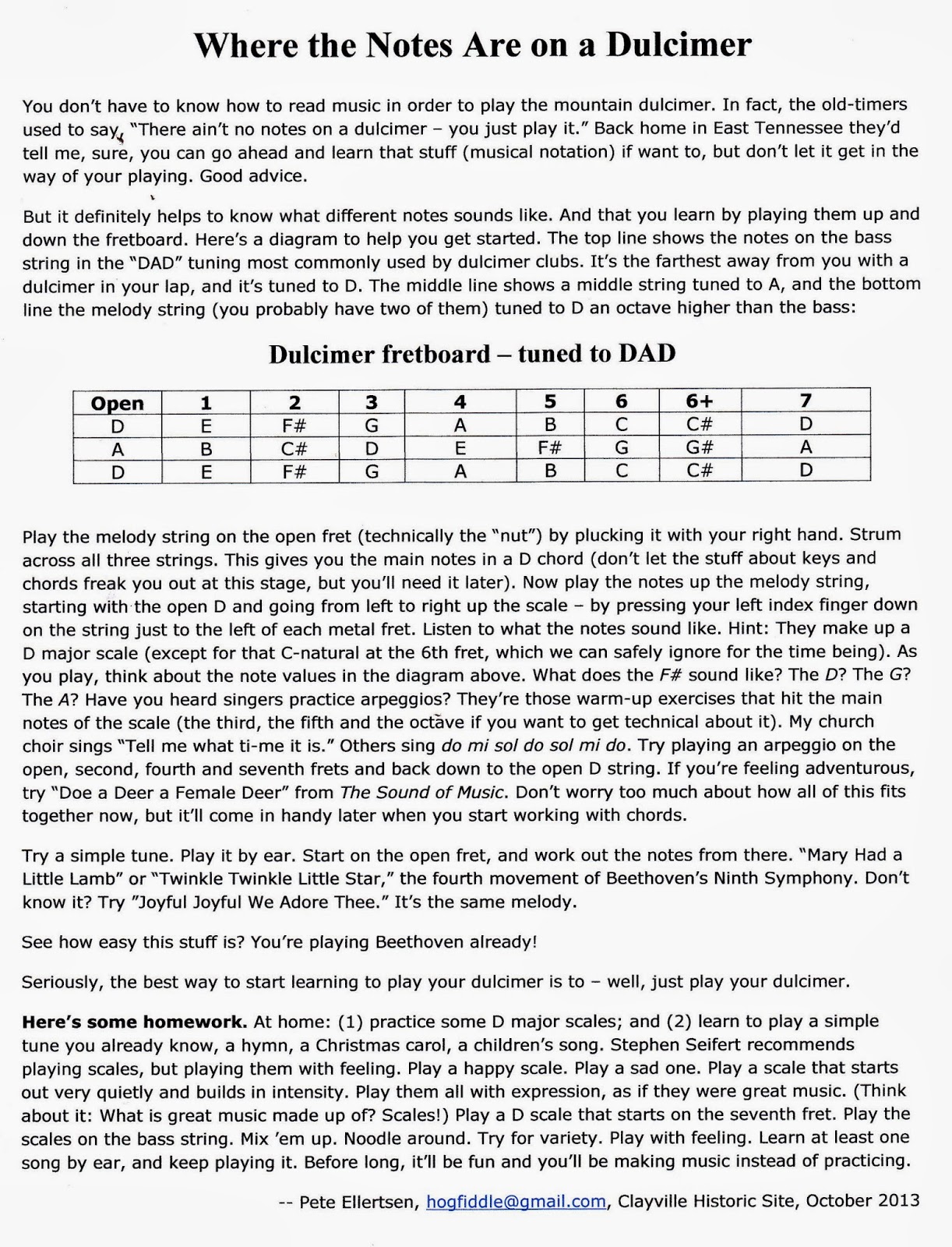
"Where the Notes are on a Dulcimer" -- revised tip sheet for Clayville

Blast email sent out to my Clayville Pioneer Academy of Music list this morning ...
Hi everybody --

Last night I sent out a tip sheet for beginners titled "Where the Notes are on a Dulcimer," and I should have proof-read it one more time! So if you printed it out, please throw out the hard copy. And if you haven't yet, please delete it. There's a pretty egregious error in it, and I'm attaching herewith a revised copy.

(I won't tell you what the error was. When I wrote for newspapers, I learned to *never* repeat the error when I was writing a correction. But if it were left uncorrected, it would have you playing in something called the "mixolydian mode." I love mixolydian tunes, and I'm fascinated with modal harmony. But we don't need to get into it in a tip sheet for beginners!)

So here's the revised version of "Where the Notes are on a Dulcimer." Basically it shows you how to find the different notes of a D major scale on a mountain dulcimer. Since I tend to lose handouts or stick them in the wrong bookbag when I'm headed out to a jam session, I've also scanned it and posted the JPEG to my blog ...

Monday, September 30, 2013

Lars Esbjorn's psalmodikon at Jenny Lind Chapel

John E. Norton. “Ecclesia Plantanda”: Emigrant Preacher Lars-Paul Esbjörn and The Beginnings of the Augustana Synod. Paper presented to the Augustana Heritage Association, Bethany College, Lindsborg, Kansas, June 19-22, 2008. http://www.augustanaheritage.org/AHA_Ecclesia_Plantanda_2008.pdf ... has a good summary of Lars Esbjorn's early life and musical training:
...He was born at Delsbo in Hälsingland, Sweden on 16 October 1808, and was orphaned at the age of seven. He was taken in by a 59-year-old domestic, Christina Enman, who had been a neighbor of his parents in Ede. She saw to his education, first in Hudiksvall, then at the liberal Gävle Gymnasium, and finally in Uppsala, where he was ordained in 1832. While still an Uppsala student, he became a teacher at Oslättfors, then accepted a call in 1832 to Östervåla in nearby Uppland. He soon returned to Oslättfors Mill in 1835 as chaplain and teacher at the new Hille elementary school.

During his time in Hille, he was also the school’s and congregation’s music teacher, and became deeply interested in four part music. In 1843 he was working with dean Johan Dillner at Östervåla on a new edition of Syréen”s ”Christeliga sångbok,” for the single-stringed psalmodikon. It was published in 1849, as Esbjörn and his party of 140 others left Gävle for America. His musical experience was the beginning of a rich musical tradition within the Augustana Synod and its schools.

Also some extended quotations in the footnotes from ms. sources ...

The psalmodikon on display at Jenny Lind looks like it was strung with one melody string and eight drones. Cf. instrument at Bishop Hill. Appears to be more or less the standard size, altho' I didn't measure it.

Directory of AHA essays at http://augustanaheritage.org/essays.php

Also: Miscellaneous links I've posted to Hogfiddle ...

Norton. “Ecclesia Plantanda” p. 5, n. 2

Rev. C.O. Hultgren, a seminary student at the time, delivered a delightful description of Esbjörn ́s early years in Andover, Robert Lincoln ́s mean-spirited pranks, and faculty tensions at Springfield, in notes to C.M. Esbjörn around 1907, now filed in the Augustana College Special Collections. He writes: “...In June 1854 Esbjörn and I went to Moline. My father had a pair of good horses, and I drove them. Esbjörn was happy, and in good humor. We soon came to a deep slough. The bridge was down, and the horses had to go on the side in soft mud. They came frightened and started to jump. Esbjörn was afraid, and jumped in(to) the slough, and sank up to his knees. We arrived safely on the other side. Esbjörn did not lose his patience. He said “we must thank God that no limbs were broken. The mire on my clothes will soon dry.” The heavens became cloudy and there was a heavy mist. I had never been in Moline, so Esbjörn had to show me the road...just the prairie. Three o ́clock and no Rock River. Esbjörn said “we are din God ́s hands. Halt and let the horses graze for a while.” We sat on the grass. He started to sing Psalm 33. I sang too. He said I had a better voice than he. He said mine was natural. He said he could not sing until (after) he became a minister. In Norrland, the students went from estate to estate and sang for money, etc. “I hired a student and went with him. He sang many songs. He sang one over and over a good many times in those eight years, but I could not learn it. After my first sermon, my hostess asked me why I didnt sing the Mass. I said to her “I cannot sing.” She said I should buy me a “mellodium” (psalmodikon?). I got a few pieces of wood and made one. I learned to sing and play. I also taught music. Now, in God ́s Name, we shall continue our journey.” The fog was very thick, could not see two rods in front of you. Thee was not the sign of a house. I asked him where to go. He pointed that way, and said “the Lord, as in Israel ́s time, will show us the way.” As it was getting dark, we saw the Rock River. The long grass waived over the horse ́s head. Ten o ́clock that evening, (we) crossed the Rock River into Moline. Mr. Peterson, the ferryman, asked us to stay that night, whch we did. No services that night as was announced in Moline. We came to Moline on Saturday. ... [Parentheses in the original.]

The note goes on with recollections of the Lutheran college in Springfield, where Hultgren was a student in 1859 and 1860, including a description of Robert Lincoln, the president's son, as a troublemaker.

Psalm 33 (Wallin?) -- Jag lyfter mina händer -- http://sv.wikipedia.org/wiki/Jag_lyfter_mina_händer This almost has to be Wallin's Psalm 33 (a paraphrase of Ps. 121 by by Jacob Arrhenius in 1694) because it fits the context so well:

I lift my hands Up to the mountain of God and the house, From them he sends aid And send out their light. I the Lord always leads, As earth and sky done; He hears me when I pray, And protects me everything fast. (Trans. Google)
Wikisource http://sv.wikisource.org/wiki/Jag_lyfter_mina_händer

Melodium an alternate spelling of melodeon. ... The Exhibitions and Fairs of Massachusetts Charitable Mechanic Association, Volumes 1-5. Massachusetts Charitable Mechanic Association (Google eBook> describes "melodium" along with Seraphine as "imperfect, and must be greatly improved, bdefore they can take high rank among Musical Instruments." -- a reed organ operated by bellows -- "The low price, however, at which they are sold, and their applicability to the purposes of simple and Sacred Music, in the parlor or the vestry-meeting, will secure them a very considerable sale." keywords melodium = instrument

Saturday, September 14, 2013

Clayville Fall Festival / upcoming events / John Stinson's No. 2 in DAD-for-dulcimer / some thoughts on community

Hi everybody --

One of the best things we do in the dulcimer community in this part of Illinois is coming up next weekend. It's the Clayville Fall Festival, from 9 a.m. to 4 p.m. Saturday, Sept. 21, and 10 a.m. to 4 p.m. Sunday, Sept. 22, at Clayville Historic Site on Ill. 125 at Pleasant Plains. We hope to have people there both days playing and spreading the word about the Prairieland Strings and the Clayville Pioneer Academy of Music jam sessions. If you can come, please let me know, and I'll try to coordinate a rough schedule. Or just come on out and plop down under a tree whenever you find us!

In addition to music, the festival will feature artisans, craftspeople and artists, re-enactors, kids' activities, and brats, burgers and sodas sold by civic groups in Pleasant Plains. It's a nice village festival, and it's getting more and more like the old festivals at Clayville during Sandman State University days. More details at ...

http://clayville.org/clayville_fall_festival_2013

A couple of other things coming up:

-- Our "third Thursday" session of the Prairieland Strings is from 7 to 9 p.m. this coming Thursday, Sept. 19, at Atonement Lutheran Church, 2800 West Jefferson in Springfield. I'll send out more details directly.

-- Deanna and Pete Langheim will play for the mature mob show called "Road Show USA" Sept. 20, at 6 p.m., Sept. 21, at 1 p.m., and Sept. 22 at 1:00 p.m. At the Sacred Heart Griffin Theater, 1200 W. Washington St., Springfield. Admission is $15, and proceeds go to the Senior Center of Illinois.

-- No firm dates yet, but my presentation "Swing Low: Dwight Moody, an Original Crossover Music Artist" has been accepted for the 2013-2014 roster of the Illinois Humanities Council's Road Scholars speakers bureau. It's about spirituals, folk hymns and the beginnings of gospel music. Details at ...

http://www.prairie.org/bios/road-scholars/pete-ellertsen

JAM TUNES FOR CLAYVILLE

With an eye to the autumn fair and festival season now upon us, we've made an effort to get more fun, lively tunes that are easy to pick up at jam sessions into our repertory (or nudge them back into it if we haven't been playing them much lately). Here's a couple you can find sheet music for on line at ...

-- "Walking in the Parlor". -- trad. Appalachian -- http://www.terrylewisdulcimer.com/walking%20in%20the%20parlor.pdf

-- "Nutfactory Shuffle". -- by Gil Anderson -- http://www.suecarpenter.net/free-tab/nutfactory/nutfactory-shuffle.pdf

-- "John Stinson's No. 2". -- trad. Irish, reinvented as a mountain dulcimer jam tune in DAD! -- http://www.hsvmda.com/sites/default/files/tabs/JohnStinson2.pdf

I'll copy this email message to my blog Hogfiddle at http://hogfiddle.blogspot.com and put in hypertext links to background.

DULCIMER 'COMMUNITY'

Like other people who write and do public relations for a living, I've been known to throw around words like "community" without giving it much thought. But now and then comes a reminder there *is* a community of people who choose to make their own music on folk instruments hardly anybody else has ever heard of, and it's a nationwide community, no less.

The other day I got an email message from Nancy G. of Flat Mountain Dulcimers in eastern North Carolina, who said she was "shocked and honored" I had linked their version of "John Stinson's No. 2" to Hogfiddle a couple of years ago. Then she added, "I scrolled to the bottom of the blog to see who had written it. When I saw [the byline] 'Pete', I realized that I know who you are from attending workshops at WCU [Wesstern Carolina University]."

Which got me to thinking ...

I first heard "John Stinson's" in a jam session at Western Carolina, where I learned it from members of a dulcimer club out of Georgia -- either Macon or the North Georgia foothills, I forget which -- and some of my very best moments playing the dulcimer have been in jam sessions at Western, the annual "Dulcimerville" workshops in Black Mountain, the Indiana Dulcimer Festival, Gateway and Mike Anderson's winter weekend in Chillicothe, Ill. I even sat in once with a dulcimer club from Crossville, Tenn., when I pulled off at a rest area on Interstate 40 between Knoxville and Nashville on the Fourth of July weekend.

If that's not being part of a far-flung community, I don't know what it is!

So here's a link to the the Flat Mountain Dulcimers of Kinston, N.C., playing "John Stinson's No. 2" ...

Wednesday, September 11, 2013

"Gubben Noak" at Augie, 1870s / ** UPDATED x2 ** w/ link to sheet music in Wikimedia Common and Fredmans Sång N:o 35 / and lyrics to "Björnen sover" / guitar tab in Norwegian -- in D! and SAB in F

Oscar Fritiof Ander. T.N. Hasselquist: The Career and Influence of a Swedish-American Clergyman, Journalist and Educator. Augustana Library Publications No. 14. Rock Island: Augustana Library Publications, 1931.
The larger percentage of the Swedish population in the United States was agricultural, and it was not easy to convince farmers of the necessity of educating their children beyond the reading and writing stage. Many argued that education was detrimental, and that their children would become lazy and consider themselves too good for farm work. The Swedish=American youth did not always desire an education, declaring that they did not need to go to college to learn to plow. As for the girls, if they could cook, sew, sing in a choir, and play "Gubben Noak" (a simple piece played with one finger), they were considered accomplished by their neighbors. (70) [Parentheses in original.]
"Gubben Noak" [old man Noah] -- Fredmans Sång 35 -- by Carl Michael Bellmann is biblical parody that has become a favorite Swedish folk song and has been covered by generations of musicians from heavy metal bands to folk music troupes, performers of classical art song and student choirs. It is well known throughout Scandinavia, and I remember my Norwegian-American father whistling it after I came home from summer school in Oslo. Music at http://www.bellman.net/texter/sang.php?nr=35 on the Carl Michael Bellman Hemsida (homepage) website. It dates from the 1700s, and Noah's name is spelled variously. First verse below.

Fred Åkerström Gubben Noack.

Wikipedia at http://sv.wikipedia.org/wiki/Gubben_Noak -- first verse, as translated by Google, from

Old man Noach, Noach old man
Be a gentleman,: | |:
When he went out of the ark
Plant him on the ground
Great wine, great wine yes, yes
This he did.

Old Man Noah, baby Noah
was a gentleman
When he would eat
drop he potäta.
Old Man Noah, baby Noah
was a man of honor.

Bellman, an 18th-century poet of Stockholm who later wrote two cycles of drinking songs and whose work was well received in the court of King Gustav III at century's end, began in the 1760s by writing biblical parodies, including "Gubben Noak." The gist of the song is that Noah planted vinyards and got drunk when the biblical flood receded and the ark landed. The state church of Sweden was not amused. Says Wikipedia (again in Google's translation), "In 1768, the reactions were severe in the cathedral chapter in Lund and in a letter to diocesan priests tried to collect all copies of the old man Noach and similar biblical parodies of Bellman to have them destroyed." In spite of those efforts, and perhaps partly because of them, the song immediately soared to popularity and has remained popular ever since.

Music (in F) …

Björnen sover

Björnen sover, björnen sover
i sitt lugna bo. Han är inte farlig,
bara man är varlig, men man kan dock,
men man kan dock honom aldrig tro.

The bear is sleeping, the bear sleeping
in its tranquil stay. He is not dangerous,
only one is serious, but the fact is,
but the fact is he never believe.

Translation (such as it is) by Google

A couple of other versions:

"Life of Bellman" in Ulriksdals slottspark. A snippet from a play based on the life of Bellman, dramatizing -- and parodying -- the reaction of the state church of Sweden to Bellman and his poetry, Albin Flinkas, Janne Åström, Andreas Andersson, Johanna Cervin.

Gubben Noak med flickkören clavinova. Girls' choir in Betlehemskyrkan in Karlstad, 22 maj 2013.


http://nortabs.net/tab/3652/ -- guitar tab in D

http://vårakoret.no/download/Sanger/$Noter/Gubben%20Noah.pdf SAB (på norsk) in F

Saturday, September 07, 2013

Pioneer Swedish-American reminiscences / Käre Jesus, vi är här / Hit, o Jesu, samloms vi

When I first posted this in September I didn't make the distinction between two similar chorales, and wasn't able to get them straightened out in my mind till May 2014. See my post May 30, 2014, at:

http://hogfiddle.blogspot.com/2014/05/add-liebster-jesu-swedish-psalmbook.html

The two chorales are:

Both hymns, the first words of which are practically identical, most commonly use Ahle's tune LIEBSTER JESU. But Clausnitzer's gathering hymn was also set to a minor-key variant by Carl Wolfgang Briegel (1687) and got into the 1819 psalmbook with that tune.

I am not going to try to rewrite this post -- the information I got from the sources I consulted at the time was correct as far as it went, and the post stands as written -- but it is not the complete story. I am repeating this disclaimer here in order to (hopefully) minimize confusion.

,p.

C.J. Snodgren, "A Brief History of the Augustana Synod." The Augustana Synod : a brief review of its history, 1860-1910 (Rock Island: Augustana Book Concern, 1910). 25-27. Internet Archive. 2007.

http://archive.org/details/augustanasynodbr00augu.

... Of another congregation its minister wrote : "After a few months they began to pay attention to the sermon." Of another it is related : "The people were beside themselves with joy (i. e. over the visit of a minister). Services were announced for the following day (a Saturday) in the school-house, and all who could crawl or walk assembled. Many of them had lived there five and six years and during all that time had never heard a sermon. When they began the service by singing psalm 328 : 'Blessed Jesus, at Thy Word we are gathered all to hear Thee' (Hit, o Jcsu, samloms vi att ditt helga ord fa bora) [26] the singing was smothered by sobs and only after some minutes were they able to continue. -- -- ... [27] We have room for only two more samples : In a certain other congregation the service was carried out by one of the members. When they were through and on the way home, he called out: "Hold on, boys; I forgot to read the benedic- tion," to which they shouted back : "Save it till next time !" But in yet another a few settlers gathered in a private house to celebrate Christmas. They had procured a tree, and candles were placed in the windows. No minister was present, but a leader read the Christ- mas story in Luke 2, spoke a few heartfelt words and led in earnest prayer; and the simple service made such a profound impression on those present that all embraced each other and wept like little children. the memories and emotions that must have swept over that little gathering of pilgrims in a strange land! [Parentheses in the original.]


The melody is apparently a variant of the LIEBSTER JESU, WER SIND HIER by Johann Rudolf Ahle that's in LBW (No. 248) and other contemporary Lutheran hymnals [although, as so often happens, I can't quite hear the resemblance and don't want to push it too far]. The Augustana hymnal (1925) has Tobias Clausnitzer's words with a melody LIEBSTER JESU (No. 302) in D minor it attributes to Carl Wolfgang Briegel (1687). Same melody, in Em, in my copy of Johan Henrik Thomander Svenska Psalm-Boken Af År 1819 (No. 328).

Andreas Holmberg's blog Nätkoralboken at http://koralboken.blogspot.com/2012/10/kare-jesus-vi-ar-har-alt-koral.html has Psalm 328 in C minor and MIDI file under the heading Käre Jesus, vi är här (alt. koral) [dear Jesus, we are here (alt. chorale)] in a new translation that seems closer to the German:

Text: Tobias Clausnitzer 1663 (45 år) "Liebster Jesu, wir sind hier", övers. Petrus Lagerlöf 1694 (46 år) "Hit, o Jesu, samloms vi", bearb./nyövers. Olle Nivenius 1984
Musik: Johann Rudolph Ahle 1664 (39 år)
Lyssna till J. S. Bachs version av koralen (BWV 633)
alt. koral Johann Crüger 1653 enligt 1939 års koralbok (i bearb. av J C F Haeffner)


Hymnary.org has this on the text:

Essentially a prayer asking for illumination by the Holy Spirit as the Christian community gathers around the Lord's Word, "Blessed Jesus" is a pre-sermon hymn by Tobias Clausnitzer (b. Thum, Saxony, Germany, 1619; d. Weiden, Upper Palatine, Germany, 1684). It was first published in the Altdorffisches Gesang-Buchlein (1663) and first attributed to Clausnitzer in the Nüremberg, Germany, Gesangbuch (1676). Catherine Winkworth (PHH 194) translated the text and published it in English in her Lyra Germanica (2nd series, 1858).

Clausnitzer graduated from the University of Leipzig and became a chaplain in the Swedish army. He preached two sermons at memorable occasions: when Queen Christina ascended the Swedish throne in 1645 and when the Peace of Westphalia, which ended the Thirty Years War, was celebrated in 1648. Clausnitzer became a pastor in Weiden in 1648, where he remained until his death. In addition to "Blessed Jesus, at Your Word," his creedal hymn, “We Believe in One True God,” is found in many modern hymnals.

And this on the tune ...
LlEBSTER JESU is a rather serene German chorale that is ideally sung in three long lines and in parts with light organ accompaniment. In rounded bar form (AABA') LIEBSTER JESU (also called DESSAU and NURENBERG) was originally one of Johann R. Able's “sacred arias,” first published with Franz J. Burmeister's Advent hymn text “Ja, er ist's, das Heil der Welt" in the Mühlhausen, Germany, Neue geistliche auf die Sonntage . . . Andachten (1664). The tune was later modified and published in the Darmstadt, Germany, Das grosse Cantional (1687) as a setting for a baptism hymn by Benjamin Schmolck that had the same first line as Clausnitzer's text: "Liebster Jesu, wir sind hier." Because several sources say that LIEBSTER JESU was first associated with Clausnitzer's hymn in the 1671 Altdoifer Gesangbuch, it seems probable that the tune name derives from that hymn text.
http://www.hymnary.org/hymn/PsH/280

Notes by Jeffrey Sly on Bach prelude Leibster Jesu, 9th Sunday after Pentecost, 21 July 2013, Music @ St. Mary's Episcopal, Phoenix. http://stmarysphoenixmusic.wordpress.com/tag/liebster-jesu/:

Opening Voluntary: Chorale Prelude on Liebster Jesu, wir sind hier (BWV 731) – J. S. Bach (1685-1750)

Today’s opening voluntary is a chorale prelude on the hymn tune, Liebster Jesu, sung today as our offertory hymn, “Blessed Jesus, at thy word” (#440, Hymnal 1982). The original version of the tune was a composition of Johann Rudolph Ahle (1625-1673) and first appeared in 1664 paired with the text of an advent hymn. Ahle was born in Mülhausen, Thuringia and studied theology at the University of Erfurt from 1645-1649. He became the cantor of The Church of St. Andrew in Erfurt in 1646 and was later appointed organist of the Church of St. Blasius in Mülhausen in 1654. Ahle’s original tune, a somewhat florid and soloistic work, was later altered to a form more appropriate for congregational singing and was paired with the present text of Tobias Clausnitzer (1619-1684), Liebster Jesu, wir sind hier. It was republished in that revised form in 1687 with Clausnitzer’s previously-published text of 1663. It entered into English hymnody in the 19th century through the translations of Catherine Winkworth (1827-1878) and was first published in her work, Lyra Germanica of 1861. It was later included in The Chorale Book for England in 1863 along with its associated melody.


Wikipedia in Germany http://de.wikipedia.org/wiki/Tobias_Clausnitzerhas: "Liebster Jesu, wir sind hier, dich und dein Wort anzuhören im Evangelischen Gesangbuch (EG) Nr. 161 (Melodie: Johann Rudolph Ahle, 1664, erschienen bei Wolfgang Carl Briegel, 1687)."

Swedish Wikipedia http://sv.wikipedia.org/wiki/K%C3%A4re_Jesus,_vi_%C3%A4r_h%C3%A4r says: "Enligt 1697 års koralbok användes inte den dåvarande melodin till någon annan psalm, men borde vara Ahles tonsättning med tanke på årtalet för kompositionen." [Babylon: According to 1697 year koralbok was not the former melody to any other psalm, but should be Ahles music' with a view to the year for the composition.]

Google translation of http://sv.wikipedia.org/wiki/Käre_Jesus,_vi_är_här : "Dear Jesus, we are here is a hymn in three verses, with lyrics by Tobias Claus Nitzer from 1663 (Liebster Jesu, wir sind hier). In the year 1695 hymnal of Peter Lagerlof 1694 under the title "Hit, O Jesus, samloms we", a title which was unchanged in both the 1819 Act and the 1937 hymnals. For the 1986 hymnal was processed and partially nyöversattes hymn by Olle Nivenius 1984."


A Dictionary of Music and Musicians (1900) edited by George Grove. http://en.wikisource.org/wiki/A_Dictionary_of_Music_and_Musicians/Briegel,_Wolfgang

Briegel, Wolfgang by Carl Ferdinand Pohl

BRIEGEL, Wolfgang Karl, church composer, born 1626, originally organist at Stettin, and afterwards (see the title-page of his then published works) Music-Director to Prince Friedenstein in Gotha, and in 1660 Kapellmeister to the Duke of Saxe Gotha. In 1670 he was called to Darmstadt as Kapellmeister to the Landgrave of Darmstadt, where he remained till his death in 1710. Among the remains of Emanuel Bach was a portrait of Briegel, engraved by Nessenthaler; it represents a man of about sixty-five, of healthy and jovial aspect, and with no trace of the labour involved in so many serious compositions. Schneider (das Musik. Lied, iii. 155) says, that 'perceiving the fashion of solo songs like those of Ad. Krieger and the two Ahles to be on the wane, he returned to the composition of songs for several voices; he wrote, in fact, incessantly in all sorts of styles with much fluency but no originality, and with no adequate return for his labours.' His principal compositions consisted of sacred songs for several voices, mostly to his own words. One of his works alone, for 3 and 4 instruments (Erfurt, 1652), contains 10 Paduaner, 10 Gagliarden, 10 Ballette, and 10 Couranten. His one secular work, 'Musikalisches Tafel-Confect' (Frankfort, 1672), consists, according to its quaint title, of 'pleasant Conversations and Concertos.' His Hymn-book for Darmstadt appeared in 1687. His published works, twenty-five in number, begin with 'Geistliche Arien und Concerte' (Erfurt, 1672), and end with 'Letzter Schwanen-Gesang,' consisting of twenty Trauergesänge for four or five voices (Giessen, 1709).


Bach Cantatas website, in entry "Chorale Melodies used in Bach's Vocal Works Es ist genung, so nimm, Herr, meinen Geist," [http://www.bach-cantatas.com/CM/Es-ist-genug.htm] ment. "Liebster Jesu, wir sind hier (1664) (EGK 127, 151) with slight modifications by Wolfgang Karl Briegel (1687) and texts either by Tobias Clausnizer (1618-1684) or Benjamin Schmolck (1672-1737). Settings by Bach: BWV 373, BWV 633, BWV 634, BWV 706, BWV 730 and BWV 731."

The Organ Music of J.S. Bach: Works based on chorales (BWV 599-771 etc.) By Peter F. Williams Google eBooks

Amazon.com lists: Blessed Jesus, at Thy Word. Chorale motet for full chorus of mixed voices a cappella. [Words by] Tobias Clausnitzer, English version by Catherine Winkworth. ... [or rather, Wolfgang Carl] Briegel, 1687 Unknown Binding – Import, January 1, 1938 by Wolfgang Carl Briegel (Author) Be the first to review this item


Bach’s Chorals. Part III: The Hymns and Hymn Melodies of the Organ Works, by Charles Sanford Terry (Cambridge University Press, 1915-1921). 3 vols. Vol. 3. http://oll.libertyfund.org/?option=com_staticxt&staticfile=show.php%3Ftitle=2057&chapter=197674&layout=html&Itemid=27.

Thursday, September 05, 2013

Songs of Sweden ed. Gustaf Hägg (1909) -- audio and PDF files of sheet music

UR Research > Eastman School of Music - Sibley Music Library > Musical Scores >

https://urresearch.rochester.edu/institutionalPublicationPublicView.action;jsessionid=1742903573A0D3B19A5929A3022A1418?institutionalItemVersionId=24179

Songs of Sweden : eighty-seven Swedish folk- and popular songs / collected and edited by Gustaf Hägg ; the English translations by Henry Grafton Chapman. New York: G. Schirmer, 1909.

links to PDF file I downloaded tonight


Audio Archive > Community Audio > Swedish songbook

http://archive.org/details/SwedishSongbook

SONGS OF SWEDEN
87 folk and popular songs
English translations by Henry Grafton Chapman

Tracks 01-29 various artists
Tracks 01-25 Swedish
Tracks 26-28 English
Tracks 29-29 instrumental

TITLES
Fågelns visa (The bird's song)
När jag blef sjutton år (When I was seventeen)

NOTES
All but one of the songs are from the 1909 book "Songs of Sweden".

The "Swedish Nightingale" Jenny Lind (1820-1887) toured the United States from 1850 through 1852. "Songs of Sweden" has a number of songs from her repertoire. "Jenny Lind mania" — from another source — is a music hall number from 1850 that makes light of her emergence as the world's first modern celebrity.

The recordings of “The bird's song” and “When I was seventeen” feature the lyrics of Henry Grafton Chapman. An article in the January 26, 1913 edition of the New York Times noted his death while praising the quality of his translations.

"Ack Värmeland du sköna" (O Vermeland thou lovely) is a Swedish folk song, best known in the English-speaking world as the instrumental jazz standard "Dear old Stockholm". The song, first published in 1822, was given additional lyrics by F. A. Dahlgren and included in his 1846 play "Värmlänningarna".

VÄRMLÄNNINGARNA

Swedish-American audiences were mainly interested in theatrical productions dealing with Swedish country life such as the popular musical "Värmlänningarna" (The People of Värmland). The libretto for "Värmlänningarna" was written by F. A. Dahlgren. The music was composed by Andreas Randel or adapted from traditional sources. This six-act melodrama, written in 1846 and set in the province of Värmland, was a love story about a young peasant couple who, with considerable difficulty, overcome hostile parents and local convention. Audiences identified closely with the hero and heroine, seeing in the plot the sorts of difficulties familiar in their own lives.

The Swedish title of the play has a variety of spellings.

SONGS FROM VÄRMLÄNNINGARNA Ack Värmeland du sköna (O Vermeland thou lovely) I villande skogen (All in the dim forest) Jag sjunger och dansar (I sing and I dance) F. A. DAHLGREN SONG
Å jänta å ja' (The maiden and I)

"Värmlänningarna" was frequently performed in Minneapolis and St. Paul during the 1910s and 1920s. The Pence Auditorium at 10th and Hennepin was located in the former home of Hennepin Avenue Methodist Episcopal Church.

contents viii

9 Jag går i tusen tankar (142 A thousand things I ponder)

Jag sjunger och dansar 180


University of Michigan > Music Library Scores Collection

http://quod.lib.umich.edu/s/scores/5260591.0001.001/5?q1=132&view=image&size=100

Title: Songs of Sweden : eighty-seven Swedish folk- and popular songs / collected and edited by Gustaf Hägg ; the English translations by Henry Grafton Chapman.

Collection: Music Library Scores Collection